Learn solitaire in one sitting
How to Play Solitaire
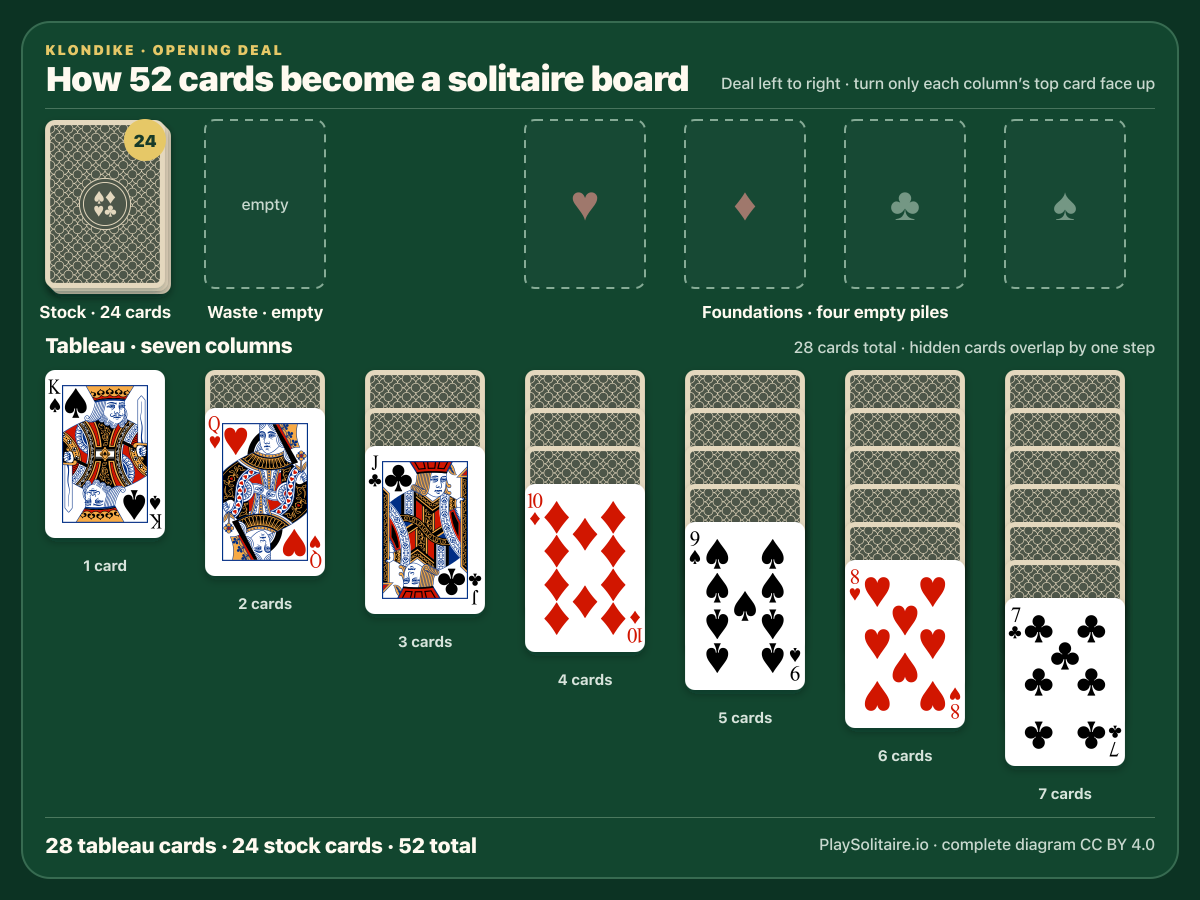
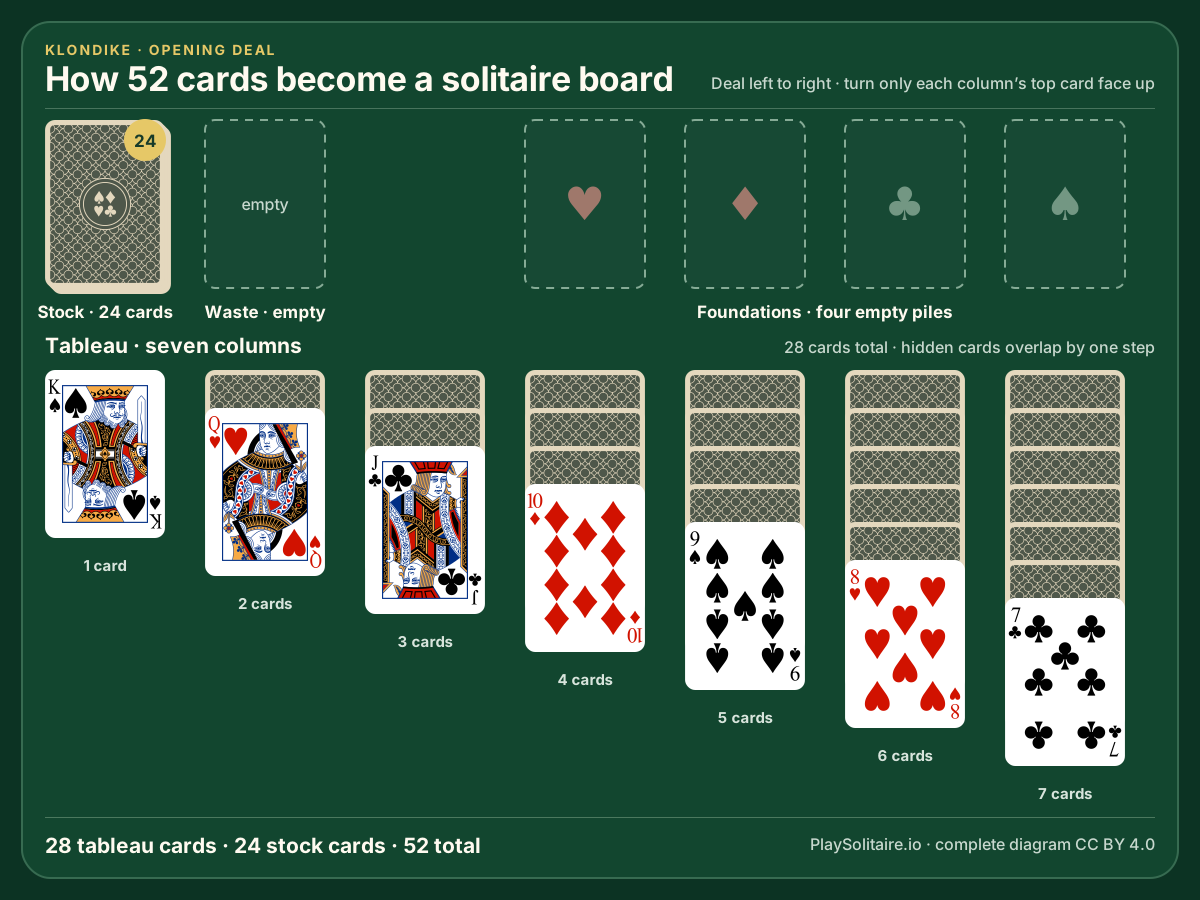
Start Klondike by dealing 28 cards across seven columns and leaving the other 24 in the stock. Only the last card dealt to each column starts face up. Build the tableau downward in alternating colors, reserve empty columns for Kings or King-led runs, and build each foundation by suit from Ace through King. Filling all four foundations with all 52 cards wins.
Learn Solitaire in 2 minutes: rules, setup and 5 tips
A quick video walkthrough of the Solitaire table, the goal, how to build, and five habits that raise your win rate. Full written rules and strategy follow below.
In this video
Languages
What you need
One standard 52-card deck with the Jokers removed — nothing else. Online, the deal happens for you; with physical cards you also want a surface wide enough for seven columns side by side. Solitaire is a one-player game in the truest sense: the shuffled deck is the opponent, and it plays a different defense every time.
How to set up solitaire
Five motions and the table is ready. This layout — called the tableau — is the same whether you deal it by hand or a website deals it for you.
- Shuffle the full 52-card deck.
- Deal in seven left-to-right rounds: first place one card in every column, then skip the first column and deal across columns two through seven, continuing until the seventh column receives the last card.
- Turn only the top card of each column face up — the other 21 stay hidden.
- Place the remaining 24 cards face down as the stock, with an empty space beside it for the waste.
- Leave room above the columns for four foundation piles — they start empty and end the game full.
The tableau holds 21 face-down cards and 7 face-up cards (28 total); the other 24 form the stock — 52 cards altogether.
 Stock · 24


Reusable visual resource
Solitaire setup and opening layout
Labeled Klondike opening layout showing 28 tableau cards, a 24-card stock, and empty waste and foundation spaces.
Solitaire setup and opening layout — PlaySolitaire.io (https://playsolitaire.io/how-to-play-solitaire#reuse-solitaire-setup-diagram), CC BY 4.0
Here is that exact layout as a live board. Click the stock to draw, drag cards between columns — it is a real deal (a winnable one), and nothing you do here touches your saved game.


The rules of solitaire
Klondike has exactly four kinds of legal move, with no mandatory order. After every move, read the board again and choose any legal move; everything after this is judgment about which move helps most.
Build the tableau down, in alternating colors
A card may land on a tableau column when it is one rank lower and the opposite color of the card beneath it: the black 9 onto the red 10, the red Jack onto the black Queen. Face-up cards already in a valid sequence move together as a unit, so a red 8, black 7, red 6 chain relocates in a single drag.


Send cards up to the foundations by suit
Foundations build upward in one suit, always starting with the Ace: A, 2, 3 and so on to the King. The top card of any tableau column and the top card of the waste are both eligible. Promoting a card is usually right — but not always, which is exactly where solitaire stops being a sorting exercise and starts being a game.
Draw from the stock when the board stalls
Clicking the stock flips cards into the waste; only the top waste card is playable. When the stock runs out, the waste turns back over and becomes the stock again, in the same order. Drawing is never a wasted turn — it is how the other 24 cards reach the game.
Flip what you uncover — and save empty columns for Kings
Whenever a move exposes a face-down card, it flips face up and joins play; releasing all 21 hidden cards is the real work of the game. And when a column empties completely, only a King — or a run led by one — may take the space, so plan the tenant before you evict.


Play your first game — three guided boards
Reading rules is slower than using them. Each board below is a real, solver-verified winnable deal with a single goal; the board watches your moves and marks the goal complete the moment you reach it. The three run independently — play any or all.
Find your first Ace
Aces open the foundations, and this deal keeps one within easy reach: scan the columns first, then draw from the stock until it surfaces. Click the Ace and it flies home.


Free a hidden card
This deal has a legal tableau move waiting in the opening position. Find the top card that fits onto another column, move it, and watch the card underneath flip into play.


Chain moves: five cards home
Now put it together — tableau builds, stock draws, and promotions in whatever order the board rewards. Complete this lesson by placing five cards on the foundations, then keep playing if you like.


Playing with real cards vs online
The paper game is identical in rules and different in feel. Dealing takes a minute instead of an instant, there is no undo, and no one stops an illegal move — the discipline is yours. Agree on two house rules before you start: how many cards to draw at once (one or three), and how many passes through the stock you allow. Online, classic Solitaire handles all of that, deals instantly, and — on this site — can even hand you a deal that is guaranteed winnable while you learn.
Deal it yourself
- 52 cards, Jokers removed
- Seven columns and room to build
- You enforce every move
Start in one click
- Instant shuffle and setup
- Illegal moves are blocked
- Undo and lessons help you learn
Draw 1 vs Draw 3
Draw 1 turns over one card per stock click and gives direct access to every stock card on each pass. Draw 3 — Klondike Turn 3 — turns over up to three cards, with only the top one playable. Playing a waste card changes which cards surface on the next pass, so plan the packet order. Measured completion rates describe different, self-selected groups of players; they do not establish how the same player would perform in both modes.
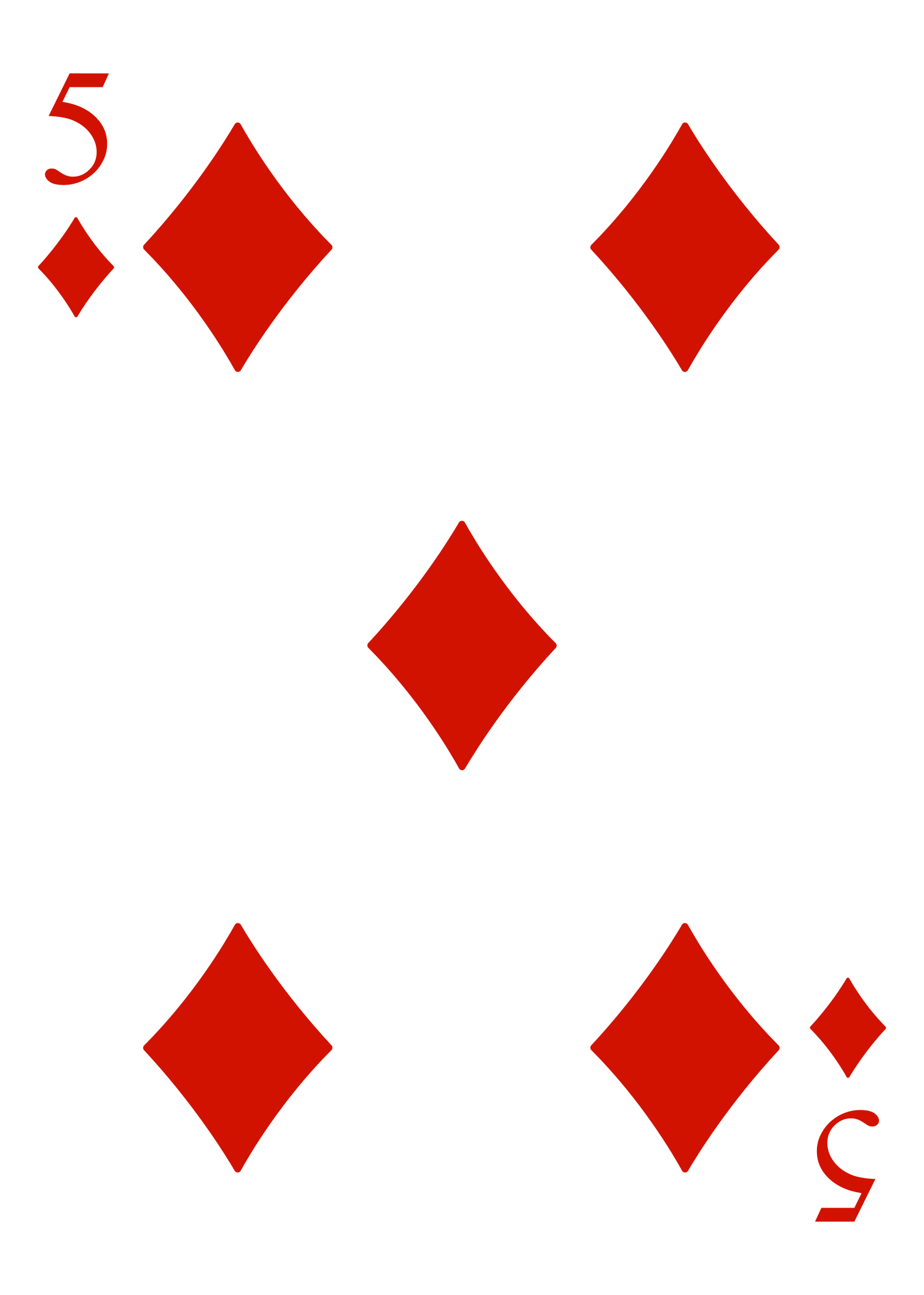
Turn over one card at a time. Best for learning the rhythm.
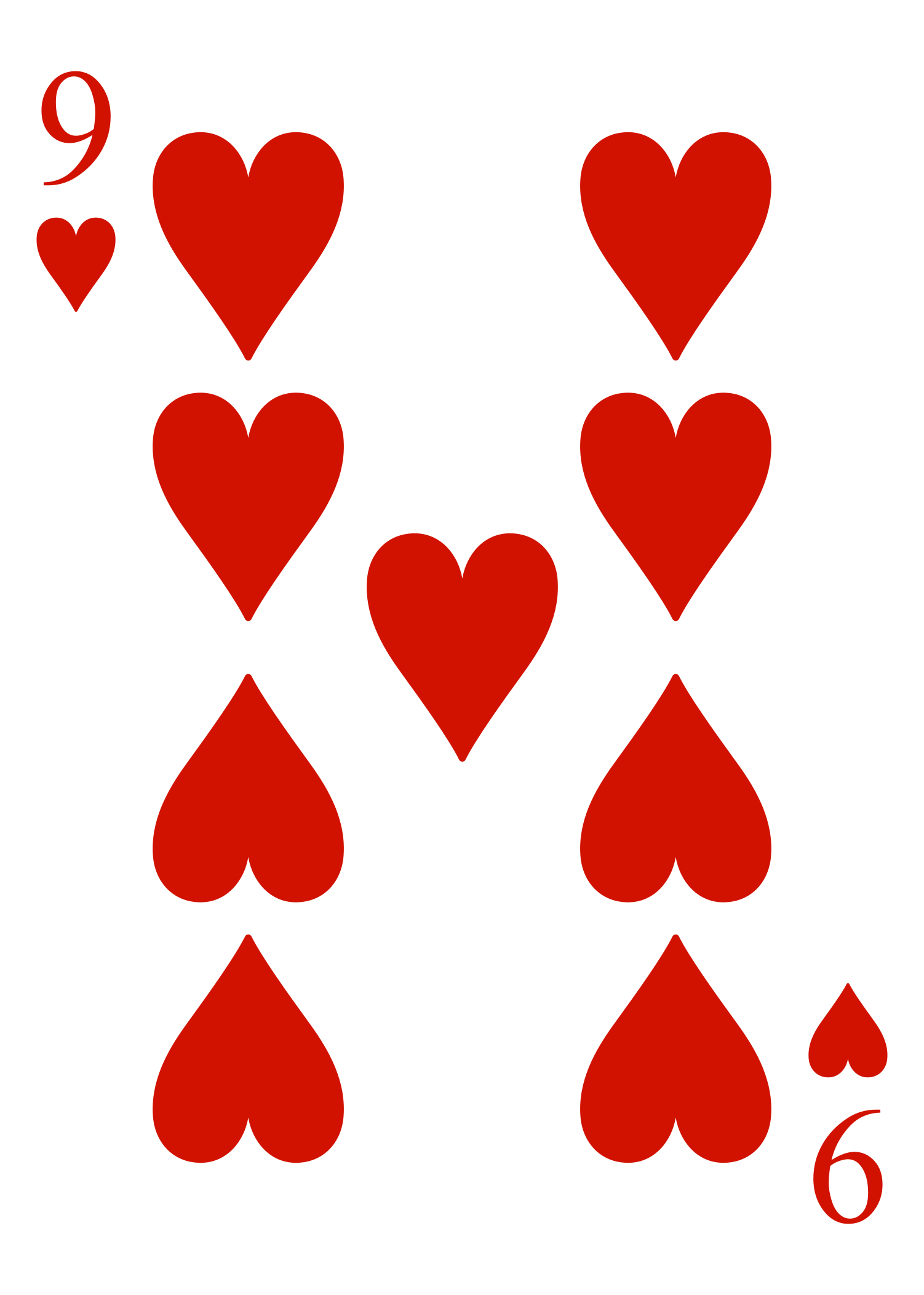
Three cards turn together. Only the top card is immediately playable.
| Draw 1 | Draw 3 | |
|---|---|---|
| Cards turned per draw | One — you see all 24 stock cards every pass | Up to three, but only the top one is playable |
| Stock visibility | Every card surfaces in sequence | Cards can stay locked behind neighbors for a whole pass |
| Planning depth | Direct — consequences of each choice are visible | Much deeper — one waste play reshuffles the rhythm of the pass |
| Best for | Learning the game | The classic next step once Draw 1 feels routine |
Seven beginner mistakes (and what to do instead)
These seven habits cost beginners more winnable games than bad luck ever will. Tap a card to flip it and see the better play.
Scoring here and traditional Vegas rules
PlaySolitaire shows your score when you win. The table compares this site’s points with traditional Vegas scoring, which is not a mode offered here. For examples across implementations, read the Solitaire scoring comparison.
| Event | PlaySolitaire | Traditional Vegas |
|---|---|---|
| Card moved to a foundation | +10 from the tableau; +15 from the waste | +$5 per card |
| Waste card played to the tableau | +5 | — |
| Face-down card flipped | +5 | — |
| Card taken back off a foundation | No point deduction | nothing refunded |
| Starting balance | 0 | −$52 buy-in per deal |
| Passes through the stock | Unlimited; each recycle costs 20 points in Draw 3, with no penalty in Draw 1 or Draw 2 | one (some rooms allow three) |
Your PlaySolitaire score cannot go below zero. Undo restores the score from before the reversed move. The Vegas comparison describes a separate convention with a $52 starting stake and $5 returned per foundation card.
How many games can you actually win?
Research places Draw 1 solvability with all card positions known at roughly 79–82%. Separately, this site’s historical June 2026 series recorded 31% completion across roughly 188,000 Solitaire games. A solver’s perfect-information result and observed player completions measure different things. The gap does not identify the cause of a particular loss; hidden cards, decisions and the players who choose each mode all affect what can be compared.
| Condition | Share of deals |
|---|---|
| Theoretically winnable with every card position known ("thoughtful" Draw 1) | ≈ 79–82% |
| Unwinnable before the first move | about 1 in 5 |
| Actually won by players on this site (Solitaire, June 2026) | 31% |

Solitaire terms, translated
Eight words cover every solitaire conversation you will ever read — including the rest of this site.
Stock
The face-down pile of 24 undealt cards. Click or tap it to draw.
Waste
The face-up pile beside the stock where drawn cards wait. Only its top card is playable.
Tableau
The seven working columns in the middle of the board. All building happens here.
Foundation
One of the four suit piles you are filling from Ace to King. Four full foundations end the game.
Run
A face-up, descending, color-alternating sequence that moves between columns as a single unit.
Build
To place cards in legal order — downward on the tableau, upward on a foundation.
Flip
Turning a face-down tableau card face up by moving away everything above it.
Recycle
Turning the exhausted waste back into a fresh stock, order preserved. Unlimited here; paper house rules often cap it.
Continue with the complete solitaire terms glossary, including cells, reserves, exposed cards, and the vocabulary used by other games.
How-to-play FAQ
How many cards do you deal in solitaire?
Twenty-eight, into seven columns holding 1 through 7 cards — the remaining 24 become the stock. All 52 cards are in play from the first move.
Do you flip 1 or 3 cards in solitaire?
Both are standard rules. Draw 1 turns over one stock card at a time; Draw 3 turns over up to three, and only the top waste card is playable. The tableau and foundation rules are the same. Draw 1 gives more direct access to the stock, while Draw 3 requires planning around packet order. Choose the draw mode above the board.
Is Klondike the same as solitaire?
In everyday speech, yes — "solitaire" almost always means Klondike, the version Windows made universal in 1990. Strictly, solitaire is the family name: Klondike, FreeCell, Spider, and Pyramid are all members with different rules.
Is solitaire played with 7 or 8 columns?
Classic Klondike uses 7 tableau columns. FreeCell uses 8 columns and 4 empty free cells. Eight Off also uses 8 columns, but has 8 cells, with 4 occupied at the start.
Can every game of solitaire be won?
No. Research estimates that roughly 79–82% of Draw 1 deals are solvable with all card positions known; a winning line is not guaranteed. Separately, this site’s historical June 2026 series recorded about 31% player completion. These figures measure different things. Our measured solitaire win rates page separates study methods, periods and results by variant.
What do I do when the stock runs out?
Click the empty stock slot: the waste flips back over and becomes the stock again, in the same order. Online play typically allows unlimited passes; stricter paper rules cap them at one or three.
Can I move a card back down from a foundation?
Yes. Move the top foundation card onto a tableau card one rank higher and of the opposite color, or move a King into an empty column. PlaySolitaire does not deduct points for this move.
How long does a game of solitaire take?
Five to fifteen minutes for most players once the cards are dealt — quick when the deal cooperates, longer when the endgame needs thought. Dealing by hand adds a minute or two; online it is instant.
Cite, reuse & print
This guide, its diagrams, and the win-rate figures behind it are maintained as a stable reference: section anchors on this page do not change. Reuse the figures with attribution, or copy a ready-made citation below.
NM Media. (2026). How to play solitaire — rules, setup & first moves. PlaySolitaire.io. https://playsolitaire.io/how-to-play-solitaire
@misc{playsolitaire_howto_2026,
  author = {{NM Media}},
  title = {How to Play Solitaire --- Rules, Setup \& First Moves},
  year = {2026},
  howpublished = {\url{https://playsolitaire.io/how-to-play-solitaire}},
  note = {Measured win-rate data as of 2026-06-30}
}
The setup diagram and the winning-game illustration on this page are licensed CC BY 4.0 — free to reuse with a link back to this page. The card-art source files themselves are not covered by this license, and the measured win-rate dataset has its own open-data terms on the win-rates page. License details ›