THE CLASSIC, BEAUTIFULLY MADE

Solitaire

Solitaire is the most-played card game in the world, and the table above is ready whenever you are: free, instant, no download and no sign-up. One standard 52-card deck, seven columns, four empty piles to fill, and one goal: build every suit from Ace to King.

Play Solitaire Learn the table

THE CLASSIC, BEAUTIFULLY MADEA lifetime of quiet strategy
52cards 7columns 4foundations

Learn Solitaire in 2 minutes: rules, setup and 5 tips

A quick video walkthrough of the Solitaire table, the goal, how to build, and five habits that raise your win rate. Full written rules and strategy follow below.

In this video

YouTube ›

It looks simple, and the rules genuinely are. The game itself is not. Roughly four out of five deals can be won in theory, yet most players win far fewer — the gap between those two numbers is where all the strategy lives. This guide covers everything in between: the exact rules and the names of the parts of the table, how scoring works in this game, the real odds of winning, the strategy habits that raise your win rate, and a little history about why a card game is named after a gold rush.

The Solitaire Table: Stock, Waste, Tableau and Foundations

Every part of a Solitaire table has a proper name, and knowing them makes every rule and every tip easier to follow. There are four zones:

  • The tableau — the seven columns across the middle of the table. This is where almost all of the playing happens. The deal puts 28 cards here: one card in the first column, two in the second, three in the third, and so on up to seven. Only the top card of each column is face-up.
  • The stock — the face-down pile in the top-left corner, holding the remaining 24 cards. You draw from it when the tableau gives you nothing to do.
  • The waste — the face-up pile next to the stock where drawn cards land. Only the top card of the waste is playable.
  • The foundations — the four empty piles in the top-right corner, one per suit. Filling all four, each running Ace, 2, 3 … Queen, King, is how you win.
Opening dealSeven columns · one face-up card in each
Solitaire opening layout Top row: the face-down stock on the left, an empty waste slot beside it, and four empty foundation slots marked hearts, diamonds, clubs, and spades. Bottom: seven tableau columns holding one through seven cards; only the top card of each column is face up. Stock · 24 Waste Foundations Tableau — 7 columns, 28 cards
The board at the start of a Klondike deal. Stock and waste sit top-left, four empty foundations top-right, seven tableau columns below - one card tall for column 1, seven cards tall for column 7.

So at the start of a game: 28 cards in the tableau, 24 in the stock, empty waste, empty foundations. Seven cards are visible. Everything else is information you have to earn.

How to Play Classic Solitaire — the Rules

Building the tableau

Cards in the tableau are stacked in descending order with alternating colors. On a black 8 you may place a red 7; on the red 7, a black 6; and so on. Suits do not matter inside the tableau — only red versus black.

Legal move
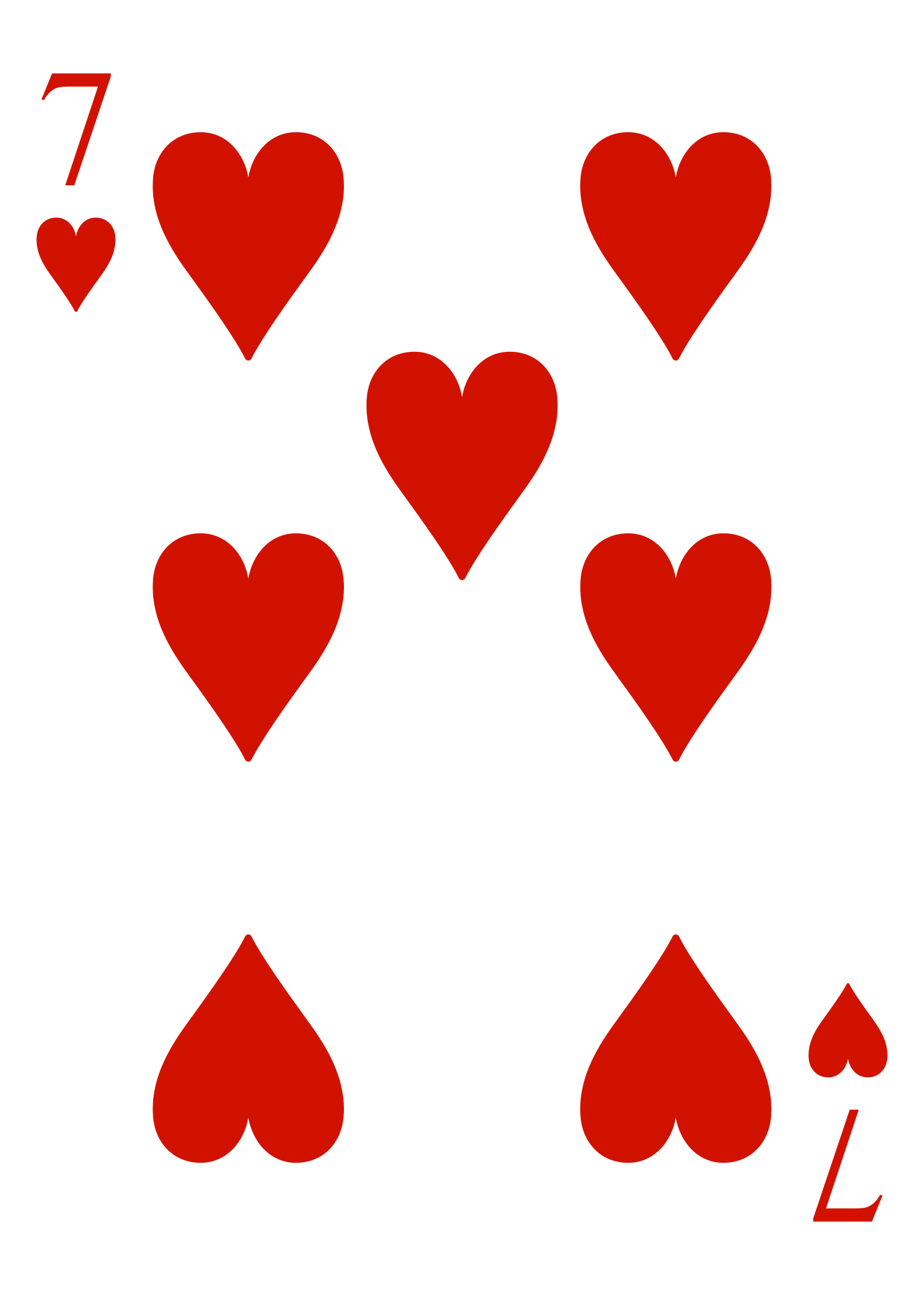
Seven of spades Eight of hearts
Black 7 on red 8 One rank lower. Opposite color.
Not allowed
Four of diamonds Five of hearts
Red 4 on red 5 The ranks fit, but the colors do not.
Not allowed
Ten of clubs Empty
10 on an empty column Only a King may enter empty space.

Face-up cards move between columns, and you can move several at once as long as they form a valid run. If a black King carries a red Queen and a black Jack, all three travel together. You may also split a run anywhere: take the Queen and Jack and leave the King behind, if that is the move you need.

Whenever the move you make uncovers a face-down card, that card flips face-up — this is the engine of the whole game. Run out of face-down cards in a column and the column becomes an empty space. Only a King (alone, or with the run built on it) may be moved onto an empty column.

A worked example makes the logic click. Say column three shows a red 9, and the black 8 you want to move sits in column five with a red 7 on top of it. Move the 8 and the 7 travels together as a run onto the 9 — and whatever lay face-down beneath the 8 in column five flips over. One move, three things gained: a longer ordered run, a fresh card revealed, and a shorter pile of unknowns. That triple payoff is what a "good move" in Solitaire usually looks like.

One move. Three gains. Move the run, open the board.
Before
Nine of hearts Landing card
Face-down card Eight of spades Seven of hearts
Move this run
After
Nine of hearts Eight of spades Seven of hearts
Longer run
Four of diamonds revealed 4♦ revealed
The 8♠ and 7♥ move together onto the 9♥. The hidden card flips, the useful run grows, and one unknown disappears.

One rule beginners often miss: you cannot move a face-down card, ever, and you cannot rearrange the order inside a valid run — runs move whole or split at a card boundary, nothing else. If the game refuses a drag, the reason is always one of three: wrong color, wrong rank, or a non-King heading for an empty column.

Try it on a real deal — this practice board is separate from your game above.

Goal: Flip one face-down card.

Drawing from the stock

When the tableau offers nothing useful, you draw from the stock. Depending on the mode you play, each draw turns over either one card or three. Drawn cards land on the waste, and the top waste card can be played onto the tableau or straight onto a foundation.

When the stock runs out, the waste is turned back over to form a new stock, in the same order — nothing is shuffled. You can recycle the stock as many times as you like, though in Draw 3 each recycle costs points (more on that below). Cards move from the stock to the waste to the table — never back into the stock by your own hand.

Because nothing shuffles, the stock is not random after your first pass — it is a sequence you have already seen. Strong players treat the first run through the stock as reconnaissance: note where the Aces, low cards and needed colors sit, and plan tableau moves so the right waste card is on top when its moment comes. In Draw 1 this is straightforward; in Draw 3 it becomes the heart of the game, since playing or skipping a single waste card changes which of the following cards surface for the rest of the pass.

Filling the foundations

Each foundation belongs to one suit and must start with its Ace. Aces are either waiting in the tableau or hiding in the stock; once you uncover one, send it home — drag it, double-click it, or let 1-Tap Move do it. After the Ace, the foundation accepts only the 2 of that suit, then the 3, and so on up to the King.

Practice it here: dig out an Ace and start a foundation.

Goal: Play any Ace to a foundation.

Foundations are not a one-way street. The top card of any foundation can be brought back down to the tableau when you need it — say, a red 5 to host a black 4 that is blocking something important. It costs you progress, but it often buys the move that wins the game.

When all 52 cards reach the foundations, the game is won. In practice the win is decided earlier: the moment every face-down card has been flipped, nothing can stop you — the game offers to finish the rest automatically.

How Scoring Works

This game uses standard Solitaire scoring, and every point comes from making real progress:

  • +10 for each card moved onto a foundation
  • +5 extra when that card comes straight from the waste (so waste-to-foundation is worth 15)
  • +5 for every face-down tableau card you flip
  • −20 for recycling the stock in Draw 3 — Draw 1 recycles free

The score never drops below zero, and alongside it the game tracks your move count and time, so you can chase whichever number motivates you: a higher score, fewer moves, or a faster finish. (Some apps offer a casino-style "Vegas" scoring variant where you buy the deck and earn money per foundation card — a different gamble entirely; the classic system above is the one used here.)

+10to a foundation +5reveal a hidden card −20Draw 3 recycle

Draw 1 vs Draw 3: Which Should You Play?

The single biggest difficulty switch in Solitaire is how many cards each draw turns over. Draw 1 shows you every stock card in sequence — you will see all 24, one at a time, every pass. Draw 3 turns three at once but only the top one is playable, so cards can stay locked behind their neighbors for a whole pass, and the −20 recycle penalty discourages endless cycling.

DRAW 1 See every card One card turns over. Every stock card becomes available each pass.
DRAW 3 Plan the packet Three turn over, but only the top card can move.
Draw 1 Draw 3
Cards turned per draw One — you see all 24 stock cards every pass Three, but only the top one is playable
Stock visibility Every card surfaces in sequence Cards can stay locked behind neighbors for a whole pass
Planning depth Direct — consequences of each choice are visible Much deeper — one waste play reshuffles the rhythm of the pass
Best for Learning the game The classic next step once Draw 1 feels routine
Site data, June 2026: Draw 3 players here actually win about as often (33%) as Draw 1 players (31%) — experienced players choose the harder mode. For the same player, Draw 1 deals remain far more forgiving. Play Solitaire Draw 3 — 3-card solitaire ›All win rates ›

The difference is dramatic: far more deals are winnable in Draw 1, and won more often. If you are learning, play Draw 1 — you will see the consequences of your choices clearly. If Draw 1 has become routine, Draw 3 is the classic next step: same rules, same table, much deeper planning. You can switch modes any time in the settings; the change deals a fresh game.

Can Every Solitaire Game Be Won?

No — and anyone who tells you otherwise is repeating a myth. Computer analyses of classic Solitaire with perfect information ("thoughtful solitaire", where every card position is known) put the share of theoretically winnable Draw 1 deals at roughly 79–82%. About one deal in five is lost before you make your first move — most often because key cards, usually Aces or the cards needed to free them, are buried beyond reach.

PERFECT INFORMATION ≈ 4 in 5

deals have a winning line

The fifth can be lost before your first move. Real play is harder because hidden cards force decisions without perfect information.
Condition Share of deals
Theoretically winnable with every card position known ("thoughtful" Draw 1) ≈ 79–82%
Unwinnable before the first move about 1 in 5
Actually won by players on this site (Solitaire, June 2026) 31%
Measured across roughly 188,000 Solitaire games played on this site in June 2026. The gap between 80% winnable and 31% won is not luck — it is the strategy section below. Win rates for every game ›

Real-world win rates are far lower than 80%, because you play without seeing the face-down cards: a deal that is winnable on paper is easy to lose with one wrong guess. That gap is exactly why strategy matters — you cannot fix the unwinnable fifth, but you can stop donating winnable games.

If you do hit a dead end, this game tells you: when no legal moves remain, you will be offered the choice to undo your way back to a fork or deal a new game — no staring at a stuck table wondering.

Five Common Beginner Mistakes

  • Auto-piling the foundations. Sending every playable card straight to the foundations feels like progress, but mid-rank cards often still have tableau work to do. The classic self-inflicted loss is banking a red 5 you later need as a home for a black 4.
  • Emptying a column with no King in sight. An empty column that nothing can legally fill is a dead zone — you gave up a working pile for it.
  • Drawing from the stock too early. Each draw buries the waste one card deeper. Exhaust your tableau moves first; the stock is not going anywhere.
  • Moving runs for no reason. Shuffling a run between two columns that both stay covered achieves nothing and, in scored play, wastes moves. Every move should either flip a card, free a card, or build toward a foundation.
  • Ignoring the move counter. Efficient play is a skill of its own. If your wins routinely take 150+ moves, you are winning despite leaks — the habits below patch them.

Solitaire Strategy: Seven Habits That Raise Your Win Rate

  • Flip face-down cards above all else. Every flip is new information and new options. Given two legal moves, take the one that uncovers a hidden card.
  • Send Aces and 2s home immediately. They are nearly useless in the tableau and their foundations unlock everything that follows.
  • Dig the long columns first. A move that helps column seven (six hidden cards) is usually worth more than one that helps column two.
  • Do not rush the foundations. Middle cards — 5s through 9s — often still have work to do in the tableau. Bank them too early and you will be pulling them back down later, at the cost of moves.
  • Do not empty a column without a King ready. An empty space only accepts a King; opening one with no King available wastes the most powerful slot on the table.
  • Mind the colors of your Kings. If both black Kings are placed, you will need red Queens, black Jacks, red 10s. Building two same-color Kings can starve you of the Queens you need.
  • In Draw 3, count your offsets. The stock comes around in threes, so playing one card from the waste shifts which cards surface on the next pass. If a pass gave you nothing, spend a card early in the next one — it re-deals the rhythm of everything behind it.

Put the seven habits to work on one deal.

Goal: Get five cards onto the foundations.

Undo, Hints and Honest Cheating

With physical cards, "cheating" means peeking under face-down piles or sneaking a non-King onto an empty column. Online, illegal moves are simply impossible — the game will not accept a card where it cannot go, and nobody can lift the corner of the stock.

What you do get is undo, unlimited and judgment-free. Purists treat it as a confession; we would argue it is the best teacher the game has. Rewinding a lost line and replaying the fork differently shows you, concretely, which decision sank the game — the lesson sticks far better than a loss screen ever could.

There is also a hint when the table has you stuck: it points out an available move (and when it has nothing to point at, that is information too). Between undo, hints and the dead-end notice, you are never left guessing whether the game is still alive.

UndoTry another line HintFind a legal move Dead-end checkKnow when the deal is stuck

Why It Is Called Klondike: a Short History

Patience games — the family name for single-player card games — were a European craze through the 19th century. The version we now call classic Solitaire picked up the name Klondike around the 1890s, after the Klondike region of the Yukon, where it is said to have been a favorite way for gold-rush prospectors to pass brutal northern winters. Whether miners truly played it between claims or the name was just good marketing, it stuck.

The name question has one more wrinkle: in Britain the whole family of one-player card games is called patience, while Americans say solitaire — which is why the same game answers to "Klondike", "classic Solitaire" and "patience" depending on where the player grew up. (A near-identical cousin called Canfield, named after a casino owner who sold deals of it as a gamble, is often confused with Klondike in older rule books.)

The game’s second gold rush came in 1990, when Microsoft shipped it free with Windows 3.0 — partly, famously, to teach a generation of office workers how to drag and drop with a mouse. That single decision made Klondike the most-played computer game of its era, decades before "casual gaming" had a name. The version you are playing above is the direct descendant of that green felt window.

1890sKlondike name appears 1990Windows brings it to millions 2026A quiet classic on every screen

Beyond Classic Solitaire: Other Games to Try

Classic Solitaire is only one member of a much larger card-game family. Three relatives are worth knowing:

Spider deals two decks across ten columns and asks you to build full King-to-Ace runs in a single suit. The one-suit version is a gentle puzzle; the four-suit version is one of the hardest popular card games there is.

FreeCell deals every card face-up and gives you four spare "free cells" as parking spaces. Nothing is hidden, so it is almost pure skill — and famously, nearly every deal is winnable: of Microsoft’s original 32,000 numbered deals, exactly one (#11982) has no solution.

Pyramid stacks the deal into a triangle and has you remove pairs that sum to thirteen — quick, light, and a completely different kind of thinking.

Golf and TriPeaks round out the quick-game corner of the family: both deal a layout you clear by playing cards one rank above or below the waste card, trading classic Solitaire's deep planning for fast, streaky rounds.

The word "solitaire" is also used loosely for any game you play alone — sudoku, mahjong solitaire, even jigsaw puzzles get the label in casual use — but among card players, the games above are the canon.

Classic Solitaire FAQ

What are the odds of winning Solitaire?

About 79–82% of Solitaire Draw 1 deals are winnable with perfect play, but real-world win rates are much lower because the face-down cards force guesses. A rising personal win rate is a better progress measure than any single game.

Is Draw 1 or Draw 3 better for beginners?

Draw 1. You see every stock card each pass, mistakes are visible and fixable, and far more deals are winnable. Move to Draw 3 when wins stop feeling like news.

How long does a game take?

A relaxed Draw 1 game usually runs five to ten minutes. Confident players finish winnable deals in two or three, and Draw 3 stretches games out with extra stock passes.

What do stock, waste, tableau and foundations mean?

The stock is the face-down draw pile (top left). The waste is the face-up pile beside it where drawn cards land. The tableau is the seven working columns. The foundations are the four piles (top right) you fill from Ace to King, one per suit, to win.

What happens when no moves are left?

The game detects a dead end the moment it happens and says so — offering Undo, to rewind to where the deal went wrong, or a fresh game. You will never be left clicking a dead table.

Does Undo affect my score?

Undo restores the score to exactly what it was before the move, along with the cards. It costs honesty points with purists, nothing else — and as a learning tool it is unbeatable.

What is auto-complete?

Once every card on the table is face-up, the outcome is settled — no sequence of moves can lose from there. The game offers to finish for you, flying the remaining cards to their foundations and saving you fifty clicks of mop-up.

Is Solitaire good for your brain?

It is genuine light exercise for planning, working memory and sequencing — you hold hidden-card possibilities in mind while ordering moves. It will not replace a workout or a textbook, but as screen time goes, it is honest: a few quiet minutes of thinking, no noise, no feed.

All solitaire games

Classics

Solitaire You are here

the classic Solitaire game everyone knows, one card drawn at a time

Players win 31%

Solitaire Draw 3

the three-card draw (3-card solitaire), on its own board with its own saved game

Players win 33%

Daily challenge

a new deal at midnight UTC, every one winnable — keep the streak going

Spider family

Spider Solitaire

two decks across ten columns: build full King-to-Ace runs in a single suit

Players win 50.0%

Spider Solitaire 2 Suits

the classic middle difficulty

Players win 10.4%

Spider Solitaire 4 Suits

the full expert game

Players win 1.1%

Scorpion Solitaire

build four suit runs King to Ace in place, one of the hardest solitaires there is

≥ 12.8% winnable

Wasp Solitaire

Scorpion with free empty columns: the same logic, more room to breathe

≥ 77.9% winnable

Quick games

Golf Solitaire

the fastest game in solitaire, every deal verified winnable

TriPeaks Solitaire

chain up-or-down plays to fell three peaks

96.6% winnable

Pyramid Solitaire

pair cards that sum to 13 to clear the pyramid, every deal verified winnable

Open & skill

FreeCell

every card dealt face up, so almost every deal can be won with enough care

Players win 11.1%

Eight Off Solitaire

the game FreeCell came from: eight cells, strict in-suit builds, and almost every deal winnable by the patient

≥ 97.7% winnable

Yukon Solitaire

the whole deck dealt, no stock: move any face-up group, ordered or not

≈ 75% winnable

Russian Solitaire

Yukon with same-suit building, one of the hardest solitaires there is

≈ 7% winnable

Alaska Solitaire

suit sequences that build up or down, a rare two-directional puzzle

≈ 80% winnable

Hard challenges

Forty Thieves Solitaire

two decks, one pass through the stock, no second chances: the honest brute of the family

≥ 7.7% winnable

Crescent Solitaire

Aces build up, Kings build down, and the suits meet in the middle; three shuffles to save a stuck board

≥ 45% winnable

Canfield Solitaire

the 1890s casino game: $50 a deck, $5 per card banked, and a 13-card reserve between you and breaking even

≥ 33.1% winnable

Solitaire Win Rates

what players actually win at every game here, measured from real play, beside the solver ceilings

Solitaire guides

QUICK START

How to play solitaire

Deal. Build. Finish. These three pictures cover the complete game.
Play Solitaire
01

Deal from the stock

Turn over one card or three.

02

Build downward

Alternate red and black cards.

03

Fill four foundations

Complete every suit to win.

The goal of the game

Move all 52 cards to the four foundations in the top-right corner. Each suit has its own foundation, built in order from Ace up to King. Fill all four to win.

Move cards around the table

Click the stock (the face-down pile, top left) to turn over new cards. In Settings you can choose whether each draw turns 1 or 3 cards. Drag and drop — or double-click, or use 1-Tap Move — to send cards from the waste to one of the seven tableau columns or onto a foundation. Only the top waste card is playable, and cards never move back into the stock.

In the tableau, cards stack from high to low in alternating colors: a black 7 goes only on a red 8. You can move several cards at once if they form a valid run, and when a face-down card becomes the top of its column it flips face-up automatically. An empty column accepts only a King. Tableau cards and foundation cards can move both ways whenever the order allows it.

MN Media

MN Media

MN Media is the publisher of PlaySolitaire. Our editorial team writes and maintains the game guides on this site across all of its languages, and keeps the rules, odds and strategy content accurate as the game evolves.

Read more ›

Contact us

We use your email only to reply. Privacy Policy