Spider lesson · setup, runs and suit modes
How to Play Spider Solitaire
Uncover cards, build same-suit descending runs, and clear eight complete King-to-Ace sequences. See how the ten-column game works, compare all three suit modes, then reveal a hidden card on a solver-verified practice deal.

 moves together
 By the end: you will understand the ten-column setup, know which sequences can move together, and have a practical rule for deciding when to deal another row.
- 104 cards
- 10 columns
- Same-suit runs move
- 1-, 2- and 4-suit data
Updated July 2026





Learn Spider Solitaire in 2 minutes: rules, setup and 5 winning habits
A quick video walkthrough of the Spider table, how runs are built and moved, what empty columns are worth, and five habits that win more games. Full written rules and strategy follow below.
In this video
Languages
Spider vs Solitaire Draw 1: what changes
Spider replaces stock-and-waste searching with a ten-column sorting problem. Four changes matter immediately.
Does Spider Solitaire use one deck or two?
104 cards across ten columns; no waste pile.
Full explanation +
Standard ten-column Spider uses two complete 52-card decks, for 104 cards total. One-suit mode changes the suit symbols, not the deck count. One-deck Spider variants use a different deal and layout; they are not the game played here.
 ←
←You build down regardless of suit
A single card may build down on any suit.
Full explanation +
A single card may go on a card one rank higher even when the suits differ. A 9♠ can sit on a 10♥. That flexibility helps uncover cards, but mixed-suit sequences do not behave like clean runs.
Only same-suit runs move together
Only a clean same-suit run travels together.
Full explanation +
A descending 8♥–7♥–6♥ can move as one unit. If those ranks mix suits, only the exposed end card can move. The board may look neatly ordered while still being mechanically stuck.


Complete runs leave the tableau
Eight King-to-Ace runs leave the board.
Full explanation +
Build King through Ace in one suit and the full 13-card run moves off automatically. Remove eight runs to win. There are no four Ace-to-King foundation piles to feed gradually.
Ready to see the ten-column board in action? Play Spider Solitaire in 1-suit mode while keeping this guide open.
Spider Solitaire setup
Spider uses 104 cards: two complete 52-card decks. The number of represented suits changes with the selected difficulty, but the ranks and layout do not.
- 01
Deal 54 cards across ten columns. The first four columns receive six cards each; the other six receive five each.
- 02
Turn only the top card of each column face up. The other 44 tableau cards begin face down.
- 03
Keep the remaining 50 cards as the stock. They form five packets of ten. Each stock action deals one new face-up card to every column.
- 04
Leave room for eight completed runs. A full same-suit King-to-Ace sequence leaves the tableau automatically.
Spider Solitaire rules
Single cards are flexible. Groups are not. Open any lesson for the complete rule.
01 Build tableau cards down by one rankBuild down exactly one rank. Complete rule+
Place any exposed card on an exposed card exactly one rank higher. Suit does not matter for a single-card move: a black 9 can go on a red 10, and a red 9 can go on a black 10. You cannot skip ranks or build upward.
02 Move a run only when every card shares a suitA group moves only when every suit matches. Complete rule+
A descending sequence can move as a group only if it is continuous and all one suit. A mixed 9♠–8♥–7♠ may be built legally one card at a time, but it cannot be lifted as a three-card unit.
03 Move any available card or movable run to an empty columnAny card or clean run may use empty space. Complete rule+
 any card or clean run
An empty column is Spider’s most flexible workspace. It accepts any exposed card or legal same-suit run. Use it to separate mixed sequences, expose a hidden card, and rebuild a clean run—not simply to park the first awkward card you see.
04 Deal one card to every columnOne stock action covers all ten columns. Complete rule+
A stock deal places ten face-up cards, one on each tableau column. Those cards can cover useful sequences, so finish all productive moves first. A fresh row is a board-wide commitment, not a harmless draw.
05 Remove King-to-Ace runsA complete same-suit K-to-A run disappears. Complete rule+
When one column contains K–Q–J–10–9–8–7–6–5–4–3–2–A in the same suit, that run leaves play. Clearing all eight complete runs wins the game.
Need a vocabulary refresher? See Spider terms explained before comparing mixed and same-suit runs.
Can you deal when a column is empty?
Rulebooks differ on dealing with an empty column. Classic Microsoft Spider requires every column to contain at least one card before a stock row can be dealt. PlaySolitaire allows a deal while a column is empty. The interface enforces the version you are playing; strategy still favors using the empty space before adding ten new cards.
1, 2 or 4 suits — rules and player results
More suits create more conflicts. These player results come from separate cohorts; the published solvability estimate answers a different question.
Best place to learn
1 suit
Every continuous descending sequence is same-suit and can move together.
Suit planning begins
2 suits
Mixed-suit builds are legal, but only same-suit runs move together and clear.
The full challenge
4 suits
The same movement rule applies across four suits, creating more conflicts.
Player cohort: starts July 15–August 3, 2026; outcomes observed through August 5 · Read the methodology · win-rates-v2-2026-10-09
How to choose a suit mode
Player win rates mix skill levels, abandoned starts, undo use, and device contexts. They show what actually happened here, not what perfect play could achieve. The sample and measurement window are displayed beside every percentage so a young or sparse row cannot masquerade as settled truth.
Start with 1 suit until you can create empty columns deliberately and delay stock deals. Move to Spider Solitaire 2 Suits when same-suit planning feels natural. Choose the full 4-suit game when you want the hardest sorting problem rather than the fastest learning loop.
Four-suit Spider also appears among the hardest solitaire games ranked by real player results.
Strategy: how to win more
Spider strategy is a competition for mobility. Use this order before dealing another row.
01 New information beats cosmetic order.Reveal a hidden card before tidying visible cards Open tip+

If one move flips a face-down card and another merely extends a visible stack, prefer the reveal unless the move destroys a critical clean run. A revealed card adds information and may create another move; cosmetic order alone does neither.
02 Clean runs preserve movement.Keep same-suit cards together when the cost is reasonable Open tip+
Mixed builds are legal temporary scaffolding. Clean them when you can, because only same-suit runs move together and ultimately leave the board. Do not refuse every mixed placement, though: exposing a hidden card is often worth a temporary impurity.
03 Empty space is a tool, not storage.Treat an empty column as active workspace Open tip+
An empty column lets you unpack a mixed sequence and rebuild it in suit. Plan the entire mini-sequence before filling the space. If you occupy the empty column with a King and cannot move that King again, the workspace has vanished.
04 The stock changes every column at once.Make every useful move before dealing Open tip+
Scan for hidden-card reveals, same-suit joins, and a possible empty column before touching the stock. The new row may cover all ten endpoints. Undoing a bad deal decision is harder than undoing one tableau move because the whole board changed.
05 A long run still needs somewhere to land.Build lower ranks with an exit in mind Open tip+
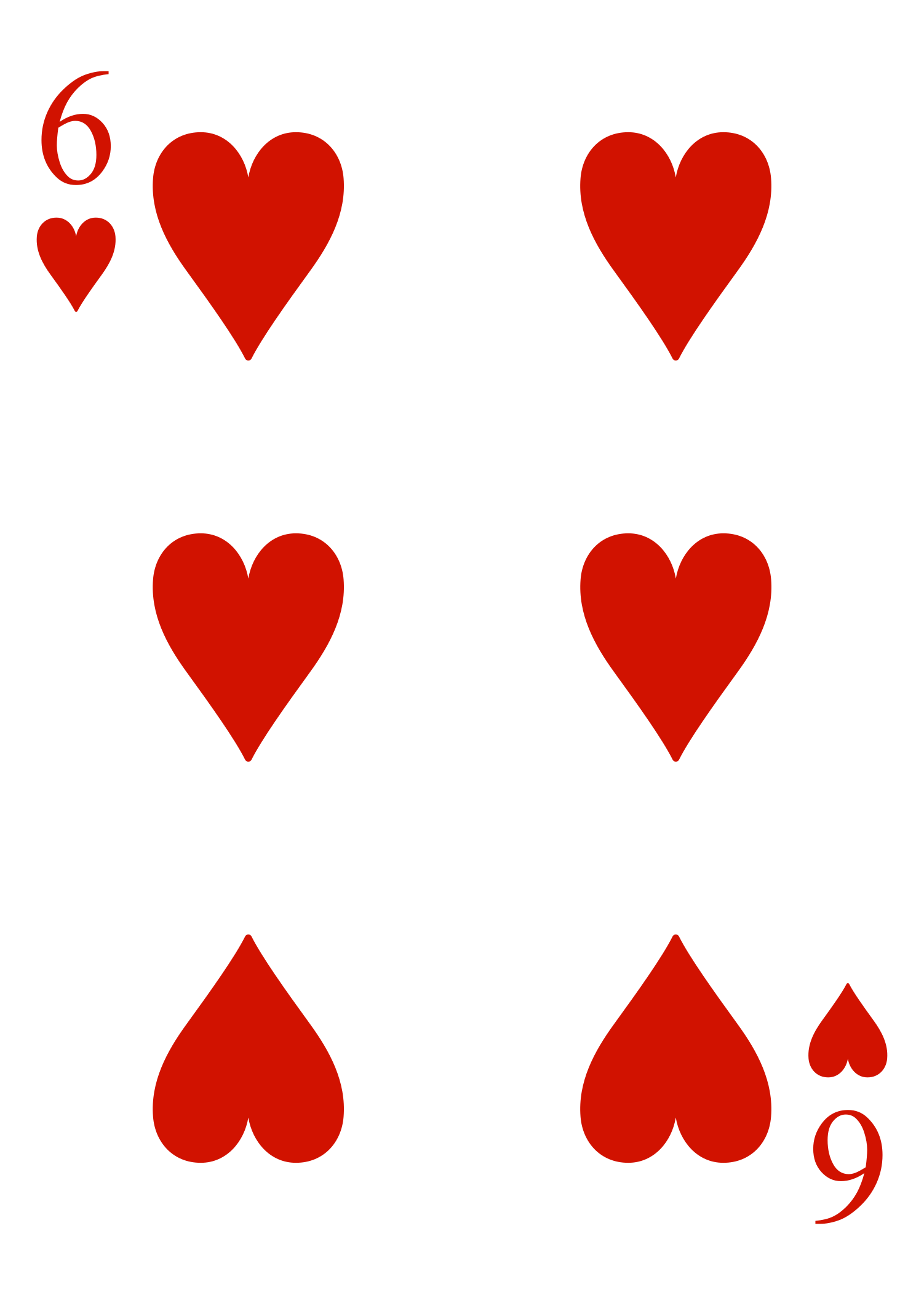
 needs a 9
A long run is valuable only if its base can eventually land on the next rank. Before assembling 8 through 3, locate a compatible 9 or a route to an empty column. Otherwise the neat run may become a wall over the cards below it.
Your move order: reveal a card → preserve empty space → join the same suit → improve mixed stacks → deal last.
Practice: a guided first game
Three fixed, solver-verified 1-suit deals build the habits in order. Start with information, then make a movable run, then create the empty workspace that unlocks stronger play.
01 Fixed 1-suit lesson · seed #200000
Reveal one hidden card
Flip one hidden tableau card. Start here +
Fixed 1-suit lesson · seed #200000
Reveal one hidden card
Flip one hidden tableau card.Find a move that removes the face-up end of a column and flips the hidden card underneath. Prefer a same-suit placement when more than one reveal is possible.


02 Fixed 1-suit lesson · seed #200009
Build a four-card movable run
Build a same-suit run at least four cards long. Build mobility +
Fixed 1-suit lesson · seed #200009
Build a four-card movable run
Build a same-suit run at least four cards long.Join descending spades until one column holds a clean same-suit run of at least four cards. A clean run can travel together; a mixed run cannot.


03 Fixed 1-suit lesson · seed #200010
Create one empty column
Empty any tableau column. Create workspace +
Fixed 1-suit lesson · seed #200010
Create one empty column
Empty any tableau column.Clear every card from one tableau column. This deal has a short five-move route to empty space; use Hint if you want the next legal step and Restart to compare another route.

The three goals form one repeatable scan: reveal information, preserve a clean run, and make empty space. Use that scan before every stock deal, from 1 suit through the full 4-suit game.
Spider Solitaire FAQ
How many cards do you lay down for Spider Solitaire?
Deal 54 cards across ten tableau columns: six cards in each of the first four columns and five in each of the other six, with only the top card face up. The remaining 50 cards form five stock deals of ten cards.
Can you move a mixed-suit run?
No. You may build descending cards across suits one at a time, but a group moves together only when every card is the same suit and the ranks descend continuously.
Can you deal when a column is empty?
It depends on the implementation. Classic Microsoft rules require all ten columns to be occupied. PlaySolitaire allows the deal, although using the empty workspace first is usually stronger strategy.
Which suit mode should a beginner choose?
Start with 1 suit. It teaches reveals, empty-column use, and stock timing without suit conflicts. Move to 2 suits when you consistently preserve movable runs.
Is every Spider Solitaire game winnable?
No universal guarantee applies to every deal and ruleset. Many deals have winning lines, especially in 1 suit, but finding one becomes dramatically harder as suits are added.