ResearchWork, attention & leisure
What a short break
can—and cannot—do.
Feeling more refreshed and performing better are different outcomes. A useful break starts with knowing which question you are asking.
A pause in the work.
Not a promise about it.
Give the break a purpose. Give the result its own measure.
How do I feel?
Energy. Tiredness.
The experience of returning.
What can I do?
Accuracy. Speed.
The quality of the work.
An answer to one does not automatically answer the other.
“I need a break” can mean several things: I want to stop looking at a screen, change what I am doing, or have a moment with nothing else to process. None of those requests has to be a promise to produce more afterward.
The research becomes easier to read when we keep three questions separate: what people did during the pause, what changed afterward, and how that change was measured. Waiting during an airport delay is another kind of pause; time lost to a disrupted journey is not a measure of a restorative break.
01 / FEELING AND DOING
Three outcomes. Three estimates.
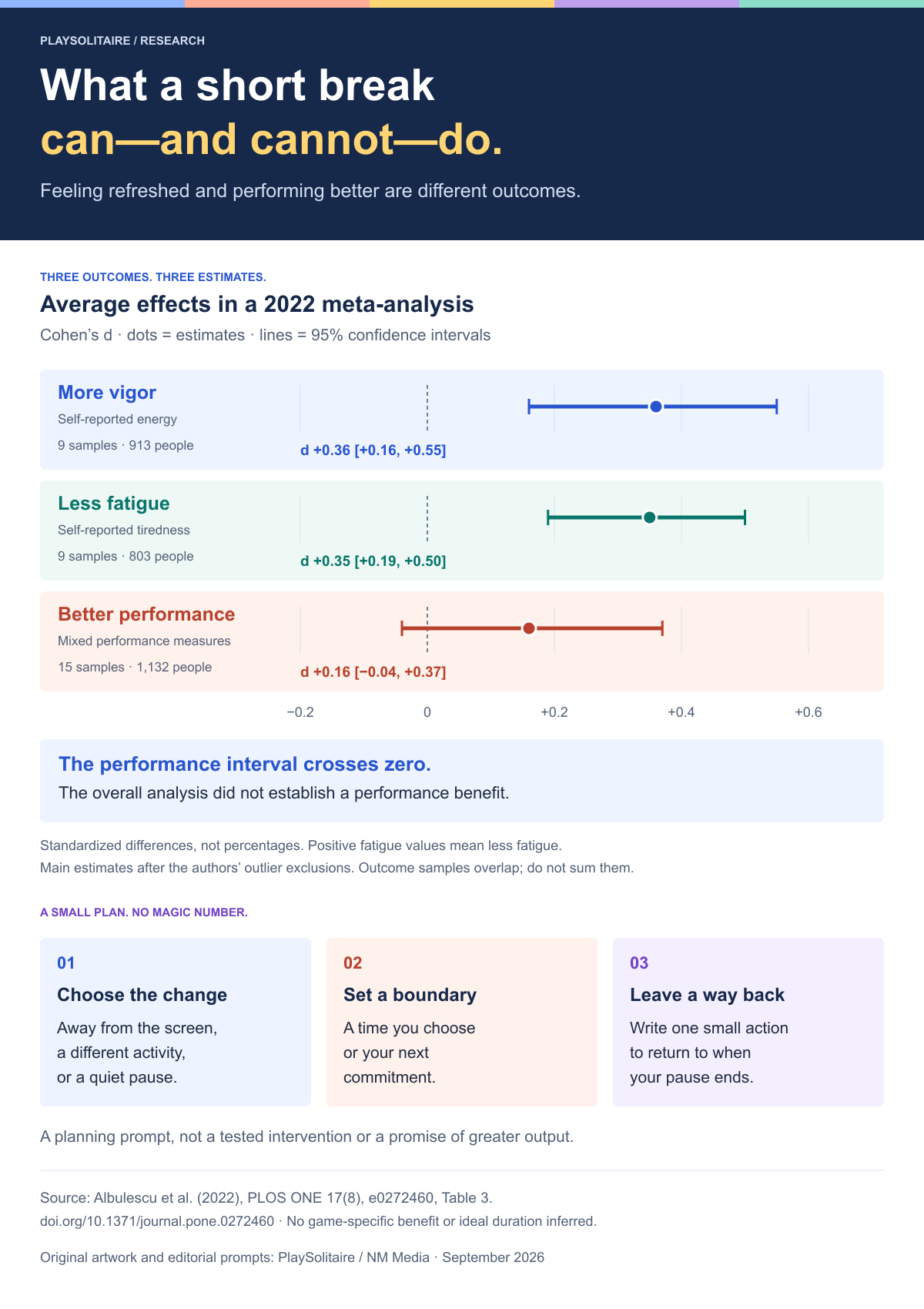
A 2022 meta-analysis by Albulescu and colleagues pooled 22 independent samples from 19 publications, covering 2,335 participants. It defined micro-breaks as interruptions of ten minutes or less. That is an inclusion rule, not an ideal break length.
Feeling better is the clearer result
Average effects and 95% confidence intervals. Positive values favor improvement.
More vigor
Self-reported energy
Less fatigue
Self-reported tiredness
Better performance
Mixed task-performance measures
Zero means no estimated difference. The performance interval crosses it; the two self-report intervals do not.
Vigor and fatigue were self-reports; performance combined different measures. The authors found small average benefits for the first two, but no statistically significant overall performance benefit. Activities, tasks, populations and comparison conditions varied.
View the exact values behind the chart
| Outcome | d | 95% CI | Samples | People |
|---|---|---|---|---|
| More vigor | 0.36 | +0.16 to +0.55 | 9 | 913 |
| Less fatigue | 0.35 | +0.19 to +0.50 | 9 | 803 |
| Better performance | 0.16 | −0.04 to +0.37 | 15 | 1,132 |
02 / READ WHAT THE EXPERIMENT ACTUALLY DID
A task switch is one particular kind of interruption
In Ariga and Lleras’s 2011 experiment, 84 students were assigned to four conditions during a 40-minute line-detection task. In the switch condition, 23 participants also made two brief digit judgments during the task. Their detection sensitivity did not decline significantly over the task blocks; it did in the other conditions.
Brief switches within a longer task
A schematic of the switch condition, not a workday timetable.
Elapsed minutes · final memory probe after the task
A promising result in one task
The brief-switch condition preserved detection sensitivity. Response times still slowed; that result did not show a clear difference between conditions.
A related test found no protection
Helton and Russell compared brief task switches, content-free cues and controls. All groups showed declining sensitivity and increasing response latency.
These studies tested related proposals with different protocols. They are a reason to examine the actual task and outcome, rather than turn a memorable experiment into a rule for every kind of work. Neither experiment tested the game examples later in this article.
03 / PICK THE CHANGE BEFORE THE ACTIVITY
What would make this a break for you?
Start with an ordinary preference, not a performance claim. If you want to leave a screen, choose something away from it. If you want a change of activity, name that activity. If you want no new input, the pause does not need another task.
Away from the screen
Put the display aside. Another app would not meet this particular goal.
A different activity
Read a page, make a small sketch or choose a leisure activity you enjoy.
Nothing extra
Leave the moment unfilled. There is no requirement to make the pause productive.
A defined activity can help describe the plan
A finite layout makes an activity concrete. For example, TriPeaks Solitaire starts with 28 cards arranged in three peaks. That describes what is on the table; it does not tell you how long a deal will take or whether it will feel like a break.
The action matters too. Pyramid Solitaire asks you to find available cards that total 13. That is a different task from reading a report, but “different” does not establish “restorative.” Pick it for the activity itself, not because a general break study has proved a benefit for that game.
04 / LEAVE YOURSELF A WAY BACK
A small plan, with no magic number
Write down three things: what you want to change, where you will stop, and the first action you will take on returning. This is an editorial planning aid, not a tested treatment or an optimal schedule. The guide to digital stopping points distinguishes finishing an item, reaching an interface boundary and completing your own task.
A fresh deal in Solitaire Turn 1 gives you a defined stock-and-tableau starting state. You can still choose your own stopping time before starting; completing or winning the deal need not be the condition for returning.
What changes? What comes next?
Choose a change and a boundary. Add a first step back if it helps.
I’ll step away from the screen until the time I choose.
When I return: choose one next step.
A different screen would not meet a goal of time away from displays.
Choose your own stopping time. The research here does not supply a universal ideal duration.
Ask two questions again
How do I feel?You can notice the experience without turning it into a score.
What is my next action?Return to the step you wrote down, then judge the work on its own terms.
You do not need to prove that every enjoyable pause increased your output. And if you do want to make a performance claim, feeling refreshed is not the measurement that settles it.
Sources, methods and limits
This is a selected evidence explainer, not a systematic review of our own or a study of PlaySolitaire users. The game examples and planning tool are editorial illustrations.
- Albulescu et al. (2022): Give me a break!
- Ariga and Lleras (2011): Brief and rare mental breaks keep you focused
- Helton and Russell (2012): Brief mental breaks and content-free cues may not keep you focused
- Huang et al. (2026): Effect of breaking up prolonged sitting with physical activity on executive function
Figure 1 transcribes the 2022 review’s Table 3; it is not a new analysis. Its bars show confidence intervals for pooled averages, not the range of effects a future study will necessarily find. Figure 2 redraws the 2011 procedure schematically. The 2012 and 2026 summaries use their primary abstracts.
The studies do not establish that these specific games improve health, concentration or productivity. There is no evidence-based completion time attached to the game examples, and no universal break duration is prescribed here.
Sources checked September 27, 2026. The full evidence notes identify the source’s inconsistent performance p-values; the chart uses its matching effect estimate and confidence interval.
A break note, not a productivity promise
Save the visual evidence summary and a plain-text planning worksheet.