ResearchHistory & visual culture
An atlas of symbols in card design.
A heart is familiar. An acorn, a cup or a hunting horn may be less so. Each can do the same useful job: tell you which suit a card belongs to.
Hearts are only
one vocabulary.
Small symbols carry identity. The deck supplies the vocabulary; the game supplies the rules.
A playing card is a compact information design. It has to distinguish one card from another, and often repeat that identity clearly enough to read across a table. But hearts, diamonds, clubs and spades are only one answer to that design problem.
This atlas compares three documented suit vocabularies, then looks closely at three museum examples. It is a guide to reading the marks—not a claim that every deck, country or century used the same system.
01 / SAME JOB, DIFFERENT SIGNS
A suit is a category. Its sign can change.
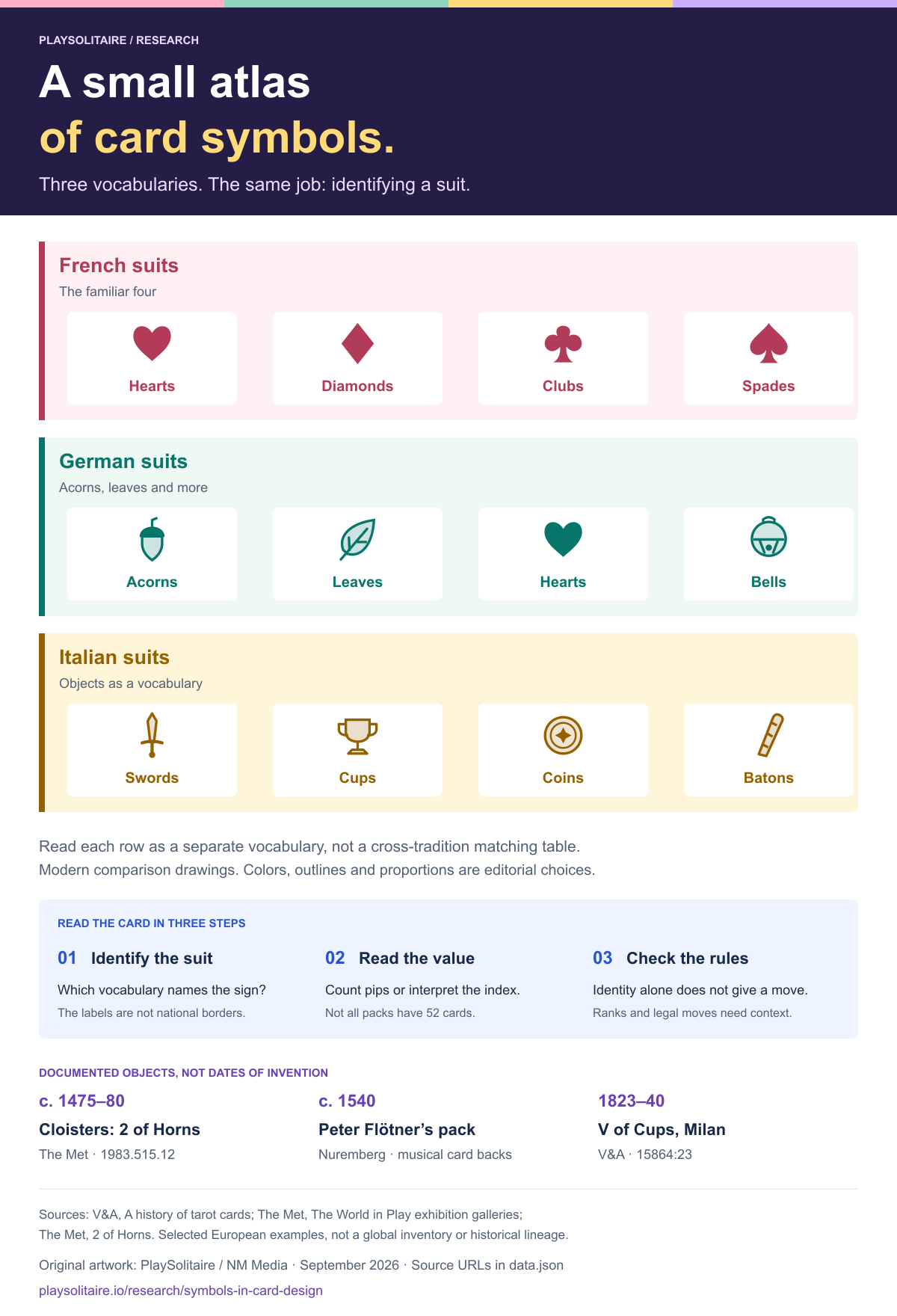
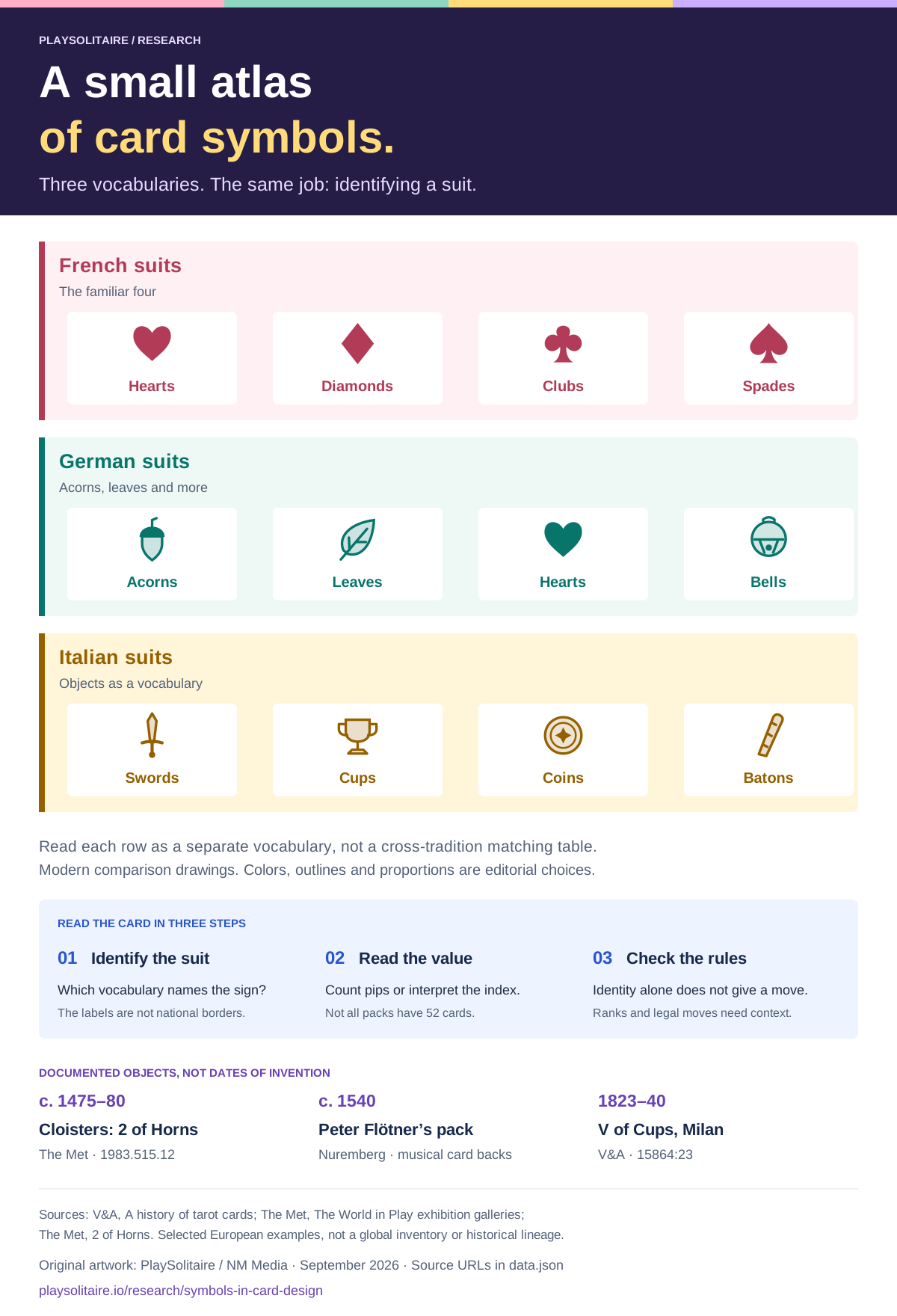
Read each panel as its own set of names. The rows do not match one tradition’s suits to another’s, and they do not show a historical progression.
Four suits, three ways to name them
English labels with original, simplified drawings.
French suits
The familiar fourHearts, diamonds, clubs and spades are the French suit vocabulary described by the V&A. The label names a system of signs, not the birthplace of every pack that uses it. Museum source.
German suits
Acorns, leaves and moreA documented example is Peter Flötner’s Nuremberg pack, about 1540: acorns, leaves, hearts and bells. These modern icons identify the named objects rather than reproduce his designs. Museum source.
Italian suits
Objects as a vocabularyThe V&A describes swords, cups, coins and batons (also called wands). Its 1891 Ace of Batons was printed in Paris: a suit-system label does not function as a national border. Museum source.
02 / FOLLOW THE OBJECT RECORD
Three objects that widen the picture
A dated object is stronger evidence than an origin story repeated without a source. These records show particular designs in particular places. Their dates do not establish when a suit was invented.
A deck built around the hunt
This 52-card set uses horns, dog collars, hound tethers and game nooses. Repeated suit signs give pip cards their values.
Collection reference: 1983.515.12
A second design on the back
The backs carry musical notation. The exhibition describes a 48-card pack, with 47 surviving cards; its four suits do not imply a 52-card total.
Collection reference: GMN Sp 7418 1–47 Kapsel 516
A named object, a dated example
The V&A records this engraved and stencilled card as a Dotti reprint of a Gumppenberg design. Its date belongs to this object, not to the invention of the cup suit.
Collection reference: 15864:23
Before the pack, a printed sheet
The V&A’s account of early card production features an uncut sheet by Gilles Savouré, dated 1490–1500: a woodcut colored with stencils. A surviving sheet lets us ask how a design was made as well as what its signs meant.
Sheet diagram: an invented arrangement, not a reproduction of Savouré’s cards.03 / TWO PARTS OF AN IDENTITY
Change the suit. Keep the count.
On a pip card, repeated signs can communicate a value as well as a suit. Choose a vocabulary, a sign and a count below. Read which part changes, and which part stays the same.
Build a card you can read
This teaching model combines a modern corner index with counted suit signs. It does not reconstruct any museum pack.
5 of Hearts
5 repeated signs supply the count. Hearts supplies the suit name.
Changing vocabulary selects its first suit and keeps your chosen count. Color and geometry are illustrative; the model is not a historical rulebook.
Separate the sign, the count and the rules. Being able to read “five of cups” does not tell you whether that card outranks another, captures it, or can be placed on it.
04 / FROM RECOGNITION TO ACTION
The symbol identifies. The rule decides.
A tiny reading guide for any unfamiliar pack
What is the mark?
Identify the suit vocabulary and its label.
What is the value?
Read the repeated pips, index or court figure.
What is permitted?
Consult the rules of the particular game.
In a familiar modern pack, the rank and suit identify a card before any move is considered. The French-suited cards in classic Solitaire offer an everyday example: “seven of spades” is the card’s identity; whether it can move depends on the current layout and the game’s rules.
A suit distinction can also define a completed group. In Spider Solitaire 4 Suits, a completed King-to-Ace run must belong to one suit. Hearts and diamonds remain different suits even though both are red. Ordinary single-card placement can cross suits; a completed run cannot.
In Scorpion Solitaire, placing a seven on a face-up eight at the bottom of a nonempty column requires the same suit. Here the symbol is operational information: it determines whether the destination accepts the card. Other move conditions still apply.
That is the value of looking closely. A small mark can be an image of an object, a category label and an instruction-bearing part of a game—all without having one universal meaning across every deck.
Sources and scope
This reference uses primary museum publications and object descriptions. It covers selected European examples, not the full global history of playing cards. Dates apply to the cited objects; they are not claimed dates of invention.
- V&A: A history of tarot cards
- The Met: The World in Play — exhibition galleries
- The Met: 2 of Horns, The Cloisters Playing Cards
- V&A: Recreating early-Renaissance playing cards
All diagrams are original simplified drawings. No museum images are reproduced. The comparison colors, shapes, arrangement and corner indices are editorial choices. The interactive model does not imply equivalent suits across traditions or reconstruct historical rules.
Museum sources and local game rules checked September 27, 2026. The source notes identify what each publication supports.
A visual reference for reading card symbols
Save the suit comparison, check the object references, or use the worksheet with a deck of your own.